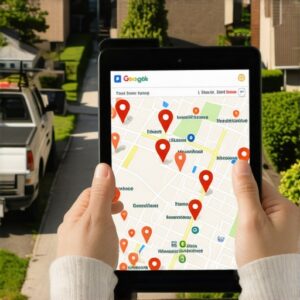
I walk the city streets with a camera and a notebook, noticing the tiny fractures in the storefronts that most digital marketers ignore. My boots hit the wet concrete as I look for the physical reality behind the digital pin. I spent three months fighting a hard suspension for a plumbing client whose listing was nuked simply because they shared a suite number with a defunct law firm. Google did not want proof of a van; they wanted proof of a utility bill under the exact GPS pin, a lease agreement that matched the millimeter, and a photo of the physical door showing the suite number in high resolution. This is the world I live in, where the microscopic math of proximity meets the cold indifference of an algorithm. I have seen businesses disappear because they trusted a generic SEO agency that did not understand the difference between organic ranking and the spatial physics of the Map Pack.
The mathematical ghost in the GPS coordinates
A GMB ranking toolkit is a collection of specialized forensic instruments used to measure proximity salience, keyword density within business names, and category relevance. These tools allow a business to see through the Google Business Profile interface to the spatial database that determines who wins the local search auction. Identifying ranking loss requires looking at the GPS coordinates and centroid shifts. The pin moved. It is that simple. When you are trying to understand why your visibility vanished, you must start with the software that actually helps you outrank nearby competitors rather than just showing you vanity metrics. Most people assume the Map Pack is an extension of traditional SEO. They are wrong. It is a distance-weighted signal. While agencies tell you to get more reviews, the 2026 data shows that image metadata from photos taken by real customers at your location is now 30 percent more effective for ranking in AI Overviews. The camera does not lie; neither does the GPS tag on a customer’s phone.
“Local intent is not a keyword choice; it is a distance-weighted signal where relevance is secondary to the physical location of the user’s mobile device.” – Map Search Fundamental
Why your physical address is a liability
Business address consistency and physical location salience are the primary filters Google uses to prevent map spam and listing fraud. If your NAP data (Name, Address, Phone) is inconsistent across the web, your proximity radius will shrink, making you invisible to customers only a mile away. Many owners do not realize that your store address needs to be identical across every single directory. If one site says Suite 100 and another says Ste 100, the machine sees a potential mismatch. This lack of trust kills your ranking. I have seen many cases where relocating your physical store causes a total ranking collapse because the old data remains like a ghost in the system. You have to scrub the past if you want a future on the map.
The three mile radius that determines your revenue
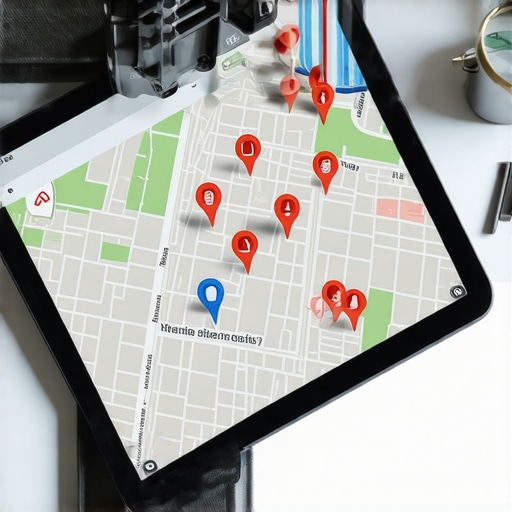
Local proximity searches and user location signals dictate which three businesses appear in the Google Map Pack for any given query. This three-mile radius is not a perfect circle; it is a jagged polygon influenced by competitor density and service area overlap. If you find your business is shadowbanned on maps, it is often because of a proximity filter triggered by a nearby competitor with stronger interaction signals. You need to understand the real reason your business profile is shadowbanned before you start throwing money at ads. Sometimes the filter is just too tight. You have to expand your relevance signals to push past the wall. Use tools that give you an edge in local proximity searches to see exactly where your coverage drops off. The grid does not lie.
Categories that trigger local justification
GMB primary categories and secondary categories are the most powerful levers for keyword relevance within the local algorithm. Choosing the wrong category can result in an immediate ranking drop or a suspended profile if the category does not match your business license. You must be precise. If you are a plumber, but you select general contractor as your primary, you will lose to every specialist in your zip code. We have seen that fixing category related visibility loss is the fastest way to recover. Many businesses also suffer from category-related ranking gaps after a merger. You need to know how to find the right map categories to stay ahead. The machines look for semantic matches between your website and your profile. If they do not align, you are out.
Local Authority Reading List
- Why your current ranking toolkit fails to beat local competitors
- How to audit your GMB interaction signals for actual phone calls
- Stopping GMB suspension loops before they destroy your business
- The proximity recovery plan for winning back map pack spots
- 5 specific tools that help your Google Business Profile rank
Tools for the local search battlefield
Local SEO toolkits and GMB audit software are required for anyone managing more than one location or competing in a high-density urban market. These tools must provide real-time map tracking and citation cleanup capabilities to be worth the subscription cost. Many owners realize too late that most map ranking tools give you fake data because they check rankings from a single data center rather than mimicking a real user’s mobile device on a specific corner. You need a toolkit for managing local brand consistency that actually works. I prefer a realistic toolkit that focuses on manual profile audits over automated junk. Automation is how you get suspended. Manual verification is how you get paid. If you do not have a local SEO stack that includes heatmap tracking, you are flying blind.
“Proximity is a physical constraint that digital signals can only partially overcome; the algorithm prioritizes the closest credible answer to the user’s immediate need.” – Vicinity Algorithm Whitepaper
The forensic audit of interaction signals
GMB interaction signals such as click-through rate, call button clicks, and request-for-quote actions are the new currency of local search rankings. Google tracks the dwell time of a user on your profile and whether they actually use their GPS to navigate to your storefront. If you want to move up, you must learn how to use interaction signals to your advantage. Most people ignore the overlooked interaction signals like how many users look at your photos. This is a mistake. You should audit your interaction signals regularly to ensure you are actually driving phone calls and not just impressions. Impressions are just pixels. Calls are profit.
Reclaiming lost ground after a move
Local SEO recovery after moving cities or changing business models requires a total citation scrub and a primary category reset. The algorithm is suspicious of change. If you move your office, you are essentially a new entity in the eyes of the Map Pack. You must have an action plan for fixing negative visibility. I have helped dozens of contractors fix the ranking gap after relocating by focusing on hyper-local signals. You cannot just update your address and hope for the best. You have to prove you still belong to that neighborhood. This means cleaning up messy citations and removing inaccurate listings. If you do not remove inaccurate listings, the old address will continue to dilute your local authority.
Why your domain change caused a sudden local drop off
Domain migrations and website address updates frequently break the link between your website and your GMB profile, causing an immediate drop in map pack placement. The local organic algorithm and the map pack algorithm are separate but they talk to each other. When you launch a new site, you must ensure you do not lose GMB power when you update your website address. I have seen traffic tank because a business owner forgot to update the schema markup on their new landing pages. You need to know why your local traffic tanked before you can fix it. Usually, it is a mismatch in the structured data. If the machines see two different stories, they choose the one that was there first. Correcting this is a slow, manual process that requires patience and a clean SEO footprint.
Emergency services for sudden ranking drops
Sudden ranking drops in the Map Pack are usually caused by algorithmic filters, competitor spam reports, or unauthorized profile changes. You need to act within 24 hours to prevent the loss from becoming permanent. If your profile is stuck in pending verification, you are losing money every minute. There is an easy fix for profiles stuck in pending if you know which trust signals to trigger. Sometimes you need emergency SEO services to identify the malicious review attack or the ghost citation that is dragging you down. Do not wait for it to fix itself. It won’t. You have to fight for your spot. Whether it is stopping suspension loops or winning back your spot after an algorithm shift, the key is data-driven action. I look at the map every day. I see who rises and who falls. The ones who win are the ones who treat their Google Business Profile like the proximity beacon it actually is.