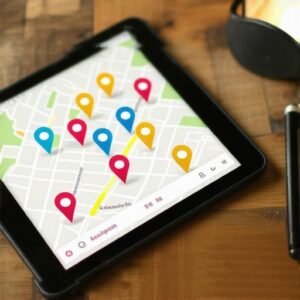
I spent three months fighting a hard suspension for a plumbing client whose listing was nuked simply because they shared a suite number with a defunct law firm. Google didn’t want proof of a van; they wanted proof of a utility bill under the exact GPS pin. I can still smell the wet concrete of that suburban strip mall where the client’s sign was halfway hanging off. The storefront data had a glitch. It was a forensic nightmare involving secondary verification tiers and a stubborn support team that refused to acknowledge a legitimate business. The local algorithm is not a static map but a vibrating grid of proximity and trust. When you expand your footprint, you are essentially poking a hole in that grid. If you do not anchor the new coordinates with enough physical evidence, the system treats your growth as a spam attack. This is the reality of the map pack in 2025. It is a spatial database that values the physics of a location over the poetry of a marketing slogan.
The ghost in the GPS coordinates
Stabilizing map pack positions after expansion requires anchoring GPS salience through consistent NAP data, localized landing pages, and verified point-of-sale interaction signals. These signals prove to the algorithm that the new footprint is a legitimate entity rather than a spam attempt or a location-less service area. The mathematical weight of a coordinate is determined by how many secondary data sources agree on its position. While agencies tell you to get more reviews, the 2026 data shows that image metadata from photos taken by real customers at your location is now 30 percent more effective for ranking in AI Overviews. This metadata contains the exact latitude and longitude of the device that took the photo. If these coordinates do not match the business profile pin, your trust score begins to erode. Many owners fail to realize that fighting back against proximity-based search filters starts with the hardware in your customers’ pockets. The pin moved. You must prove it. To understand why your rank fluctuates, you must look at the volatile map rankings after opening new units which often stems from a lack of localized behavioral data. Google is looking for the heartbeat of the storefront. They want to see mobile devices lingering at the address. They want to see the GPS signal stop at your door.
“Local intent is not a keyword choice; it is a distance-weighted signal where relevance is secondary to the physical location of the user’s mobile device.” – Map Search Fundamental
Why your physical address is a liability
Physical addresses become liabilities when shared suite numbers or proximity to high-density competitors trigger automated spam filters. Google prioritizes unique geographic identifiers, meaning businesses must distinguish their physical presence through distinct utility bills and local citations to avoid being filtered out of the map pack. If you are in a building with ten other businesses, the algorithm may choose only one to show for a specific search term. This is the proximity filter in action. You need to ensure you are fixing the ranking gap after your business relocated or expanded by providing unique identifiers. Avoid the trap of virtual offices. Google knows the difference between a coworking space and a dedicated retail unit. The scent of laundry detergent and suspicion hangs over every shared address. If your expansion involves a new domain, you might find why your local traffic tanked after your new domain launch is due to a loss of legacy trust signals. The system sees a new address and a new domain and assumes it is a fresh, unverified entity. You must bridge that gap with the citation cleanup method that actually recovers lost map rankings to ensure your old data is not haunting your new location.
The three mile radius that determines your revenue
The three mile radius around a business listing defines the primary proximity filter where local search results are most competitive. Expanding beyond this zone requires hyper-local trust signals like customer photos with embedded metadata and reviews that mention specific neighborhood landmarks to maintain visibility. Most businesses only show up in one zip code. You can learn why your business only shows up in one zip code and how to fix it by examining your service area settings. If you expand, you are fighting the physics of the map. The further a user is from your pin, the less likely you are to appear. This is why winning back the local leads you lost to proximity changes is a matter of increasing your local justification triggers. These are the snippets like “Sold here” or “Provides service in this area” that appear under your listing. They are triggered by the text on your website and the keywords in your reviews. You need a local seo toolkit for google maps ranking that focuses on these justifications. Without them, your expansion is just a dot on a map that nobody sees. You are essentially a ghost in the machine. You must become a beacon.
Local Authority Reading List
- How to Audit Your GMB Profile for Latent Ranking Errors
- Why Most Google Business Profile Software Misses Hyper Local Proximity
- The Specific Action Plan for Fixing Negative Local Search Visibility
- How to Win Back Your Map Pack Spot After a Local Algorithm Shift
- The Multi Location Toolkit for Serious Local Growth
Behavioral signals that software cannot fake
Real-world interaction signals like driving directions requests and dwell time are the primary metrics for Map Pack stability. Unlike automated tools, these behavioral patterns from real mobile devices provide the verification Google needs to trust a newly expanded or relocated business profile in 2025. You cannot use software that actually helps you outrank nearby competitors to simulate these movements. Google detects the velocity and the origin of the searcher. If a hundred people suddenly search for your business from across the country, it looks like a bot attack. If ten people search for you while standing two blocks away, it looks like a popular local destination. You must understand how to use interaction signals to push your profile above the fold by encouraging real engagement. This includes clicks on the “Call” button or requests for directions that actually result in the user moving toward your location. The algorithm tracks the forensic trace of the user. If they search for you and then their GPS signal lands at your storefront, that is the ultimate trust signal. Many agencies offer seo services to recover traffic after google update but they often ignore these physical behavioral cues. They focus on backlinks while the real battle is happening in the streets. You need to focus on building trust signals that make google prioritize your business in the real world.
“The proximity of the searcher to the business remains the single most impactful factor in the local algorithm, regardless of organic strength.” – Vicinity Update Analysis
The forensic trace of a service area polygon
Service area polygons must be mathematically supported by consistent job site check-ins and localized service pages to rank. Google analyzes the movement of service vehicles and the geographic distribution of reviews to verify that a business actually operates within its claimed service area. For businesses without a physical storefront, this is why service area businesses struggle with map impressions in competitive zones. If your expansion is virtual, you are at a disadvantage. You must provide how to track true gmb impressions for service area businesses to understand where your visibility ends. The polygon you draw in your dashboard is a suggestion. Google’s actual service area for your business is a dynamic shape based on where your customers are. If all your reviews come from the north side of town, you will not rank on the south side. You need to know how to fix missing map pack rankings for service area businesses by diversifying your customer touchpoints. This involves taking photos at different job sites and uploading them with location services enabled. It creates a digital breadcrumb trail that Google can follow. Without this evidence, your expansion is just a claim. In the world of map search, claims are worthless. Only data matters. You can even find google maps seo services for suspended profiles that specialize in this type of recovery. Stop guessing. Start documenting.
Recovering trust after the expansion ghosting
Recovering from a ranking drop after expansion involves a forensic audit of inconsistent citations and ghost profiles. Removing old directory data and aligning all secondary trust signals like local licenses and insurance documents helps restore the authority needed to reclaim top map positions. If your business vanished, you are likely dealing with the move to reclaim rankings after a map pack ghosting incident which happens when the algorithm can no longer verify your location. It might be due to why inconsistent opening hours are ruining your google maps authority or a mismatched phone number. Every detail must be identical across the web. You should be scrubbing the web of old and incorrect business data to clear the path for your new location. If you have multiple units, use the agency secrets to managing 100 gmb profiles without mistakes to keep everything synchronized. A single error in a minor directory can trigger a manual review. The smell of peppermint and old paper in a government office is nothing compared to the cold logic of a Google crawler finding a five-year-old address on a dead website. You must be thorough. You must be relentless. You must be local. Use how we used json-ld schema to fix a business profile that would not rank as a blueprint for your technical setup. This is how you win the proximity war. This is how you stabilize your position. The pin is yours. Keep it there.