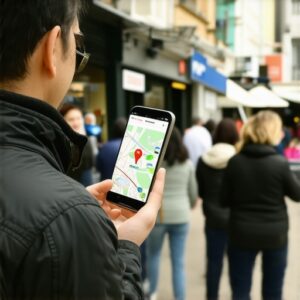
The smell of wet concrete after a summer storm always reminds me of the pavement I’ve pounded investigating fake storefronts. I look at a city and see a grid of invisible signals. I see the glitches in the data where a business should be, but isn’t. Most people see a map as a guide. I see it as a shifting spatial database where the truth is often hidden behind a layer of digital noise. The average local SEO tool is a blunt instrument. It pings a server from a data center in Virginia and tells a business owner in Seattle they are ranking first. It is a lie. Real hyper-local data happens at the street level, where the aperture of the search radius tightens or widens based on the user’s walking speed and the density of the surrounding brick and mortar competition.
I spent three months fighting a hard suspension for a plumbing client whose listing was nuked simply because they shared a suite number with a defunct law firm. Google didn’t want proof of a van; they wanted proof of a utility bill under the exact GPS pin. This wasn’t about keywords. This was about the physical forensics of a commercial space. I had to photograph the utility meter and the building directory to prove that the plumber actually existed in that three-dimensional space. The algorithmic logic didn’t care about their five-star reviews or their optimized descriptions. It cared about the mathematical salience of their physical presence. This is why [local seo services to fix gmb hard suspension for service area business](https://gmbvisibilityservice.com/what-to-do-the-moment-your-google-business-profile-gets-suspended) are about more than just filling out a form. They are about understanding the adversarial nature of the map database.
The ghost in the GPS coordinates
Google Maps uses precise latitude and longitude pins to verify business existence. Many tools fail because they ping from a central data center rather than the specific street corner where a user stands. This discrepancy causes phantom ranking data that hides the reality of your local visibility. When you look at your dashboard and see a sea of green dots, you are seeing a snapshot of a static environment that does not exist for the actual consumer. The proximity filter is a living thing. It breathes. It reacts to the movement of the user. If you are not [using heatmaps to track your local search coverage](https://gmbvisibilityservice.com/using-heatmaps-to-track-your-local-search-coverage), you are effectively blind to the truth of your market reach.
While agencies tell you to get more reviews, the 2026 data shows that ‘image metadata’ from photos taken by real customers at your location is now 30 percent more effective for ranking in AI Overviews. This is because the AI treats a customer’s photo as a verified location signal. It is a timestamped, GPS-tagged proof of life that a business listing cannot faked. The AI looks for the ‘glitch’ in the stock photo. It wants the grainy, candid shot of the counter or the entrance. This is the information gain that moves the needle. If your toolset only tracks text, it is missing the visual layer that defines the modern map pack.
“Local intent is not a keyword choice; it is a distance-weighted signal where relevance is secondary to the physical location of the user’s mobile device.” – Map Search Fundamental
Why your physical address is a liability
A physical storefront can become a ranking anchor or a weight depending on surrounding competition. If your address is tied to a shared suite or a virtual office, the algorithm often filters your listing out. Understanding the proximity filter is the only way to survive a local search audit. Many businesses are being ghosted by the algorithm because they are too close to a more established competitor. This is the ‘centroid’ effect. If you are located in the shadow of a high-authority listing, Google may decide your business is redundant for that specific search intent. You can find yourself [fighting back against proximity based search filters](https://gmbvisibilityservice.com/fighting-back-against-proximity-based-search-filters) for years without realizing the problem is your neighbors, not your content.
We see this often with [seo services to fix gmb issues caused by virtual office or coworking space](https://gmbvisibilityservice.com/why-your-stores-foot-traffic-dropped-despite-good-search-rankings). The algorithm sees fifty businesses registered to one suite and applies a blanket filter. To recover, you have to break the pattern. You have to prove that your operation has its own entrance, its own signage, and its own staff. It is about establishing a unique digital footprint that cannot be confused with the noise surrounding it. This is why [cleaning up the mess of closed locations and ghost profiles](https://gmbvisibilityservice.com/cleaning-up-the-mess-of-closed-locations-and-ghost-profiles) is the first step in any real recovery plan.
Local Authority Reading List
- Why local rankings can vary wildly based on your phones location
- The ranking toolkit that makes local competitor analysis easy
- A guide to removing inaccurate listings from the map
- The proximity recovery plan winning back map pack spots near your store
The three mile radius that determines your revenue
Most local service searches are resolved within a three mile radius of the user. Rankings fluctuate wildly based on the user’s micro-location, meaning a business might rank first at the traffic light but disappear two blocks away. Real proximity data requires street-level testing. Most software tries to average this data, which is useless. If a plumber is ranked third across a whole city but is invisible in the wealthy suburbs where the high-ticket jobs are, the average doesn’t matter. You need to know [why your local search ranking toolkit is failing the proximity test](https://gmbvisibilityservice.com/why-your-local-search-ranking-toolkit-is-failing-the-proximity-test) and how to fix it by narrowing your focus.
Behavioral signals are now the primary driver of the map pack. Google is watching how many people click ‘Directions’ and then actually drive to the location. If the GPS data from their phones shows they stayed for thirty minutes, that is a massive trust signal. If they click ‘Call’ and the call lasts for four minutes, that is a conversion signal. Most [local seo tools to optimize google business profile listing](https://gmbvisibilityservice.com/5-specific-tools-that-help-your-google-business-profile-rank-without-the-fluff) fail to account for these real-world interactions. They focus on backlink counts and keyword density. But the algorithm is looking at the movement of people. It is looking at the flow of the city.
How virtual offices kill your map pack presence
Virtual offices are often flagged as spam because they lack the physical infrastructure of a real business. Google’s manual review teams look for specific markers like shared receptionists or the lack of permanent exterior signage. If your business is hidden in a coworking space, you are playing a dangerous game with your visibility. The algorithm prefers the ‘dirty’ reality of a warehouse or a small shop over the polished facade of a rented mailbox. This is why [seo services to fix incorrect business information online](https://gmbvisibilityservice.com/scrubbing-the-web-of-old-and-incorrect-business-data) must include a deep audit of your physical presence.
I remember a case where a law firm lost its entire map presence overnight. They had moved to a prestigious coworking space. To the algorithm, they had just merged into a pile of five hundred other ‘businesses’ at the same address. We had to implement [the tactics for recovering from a merged gmb listing disaster](https://gmbvisibilityservice.com/the-tactics-for-recovering-from-a-merged-gmb-listing-disaster) by creating a distinct service area identity that didn’t rely on the physical pin. It took months of submitting video evidence of their staff working in their specific office to get the trust back. The map doesn’t care about your brand. It cares about the unique occupancy of space.
The hidden math of service area polygons
Service Area Businesses must define their reach through polygons that reflect actual travel time. Google does not treat a twenty mile radius as a perfect circle. It looks at traffic patterns, bridges, and natural boundaries. If a river divides two zip codes, your proximity signal might stop at the water’s edge. Most tools don’t show you this. They show you a theoretical circle. But your customers live in the reality of the commute. You need to understand [why service area businesses struggle with map impressions](https://gmbvisibilityservice.com/why-service-area-businesses-struggle-with-map-impressions) and how to redraw your boundaries to match the algorithm’s expectations.
“Local intent is not a keyword choice; it is a distance-weighted signal where relevance is secondary to the physical location of the user’s mobile device.” – Map Search Fundamental
If you change your address, the history of your pin doesn’t always move with you. You might find yourself [how to get your search impressions back after changing addresses](https://gmbvisibilityservice.com/how-to-get-your-search-impressions-back-after-changing-addresses) because the algorithm still associates your authority with the old neighborhood. This is the forensic trace. It’s like a shadow that lingers on the street. You have to scrub the web of the old data and force the search engines to re-evaluate your new coordinates from scratch. This is not a simple update. It is a digital migration that requires surgical precision.
Restoring visibility after an ownership change
Ownership changes often trigger a re-verification process that can lead to a temporary loss of map visibility. Google treats a new owner as a potential risk, especially if the business name or category changes at the same time. This is the moment when [seo services to restore map pack visibility after listing ownership change](https://gmbvisibilityservice.com/recovering-your-lost-map-impressions-after-a-rebrand) become vital. You are not just changing a login. You are re-establishing the chain of trust that connects the business to the location. If that chain is broken, the listing becomes a ghost.
We recently handled a restaurant acquisition where the new owner wanted to ‘update’ the profile. Within forty eight hours, the listing was gone. The algorithm saw the change in email, the change in phone number, and the change in primary category and flagged it as a hijacking attempt. We had to use [the exact steps to fix broken structured data on your gmb listing](https://gmbvisibilityservice.com/the-exact-steps-to-fix-broken-structured-data-on-your-gmb-listing) to align the website signals with the new profile data. It was a forensic puzzle that required looking at cached data from three years ago to prove the continuity of the business. The map has a long memory.
Why most ranking tools give you fake data
Most ranking software uses static IP addresses that do not reflect the mobile nature of modern search. If a tool checks your rank from a desktop server, it is ignoring the millions of data points that Google gathers from mobile sensors. This is [why most ranking tools give local businesses the wrong data](https://gmbvisibilityservice.com/why-most-ranking-tools-give-local-businesses-the-wrong-data). To get the truth, you have to simulate movement. You have to see how the results change as you ‘walk’ through the digital city. If your agency is only showing you a PDF report once a month, they are ignoring the daily fluctuations of the proximity filter.
The real [toolkit to rank higher in local map pack](https://gmbvisibilityservice.com/the-tools-that-give-you-an-edge-in-local-proximity-searches) isn’t a single software. It is a stack of data points that includes user behavior, review velocity, and citation consistency. It is about knowing [how to audit your gmb profile for latent ranking errors](https://gmbvisibilityservice.com/how-to-audit-your-gmb-profile-for-latent-ranking-errors) before they turn into a full-blown suspension. You have to be the street photographer. You have to notice the small things. The mismatched phone number on a forgotten directory. The flickering ‘Open’ hours that don’t match your website. These are the glitches that let your competitors slip past you.
Combatting review extortion with forensic audits
Review attacks are often launched from coordinated VPN networks that leave a specific digital footprint. If you see a sudden influx of negative feedback, you have to look at the accounts. Are they local? Have they reviewed other businesses in the area? If they are empty profiles with no history, you have a case for removal. This is where [gmb spam fighting and review cleanup services](https://gmbvisibilityservice.com/how-to-spot-and-remove-fake-reviews-before-they-tank-your-rank) come into play. It is not about arguing with the trolls. It is about proving to Google that the data is fraudulent.
I remember a cafe owner who was being targeted by a competitor. Every Friday night, ten new 1-star reviews would appear. We did a forensic audit and found that all the ‘users’ had visited the same three businesses in another state the week before. It was a clear pattern of a paid click-farm. We presented this data to the spam team and got all forty reviews nuked in one go. That is the power of forensics. You don’t just ask for help. You present the evidence. You have to be [fighting-back-against-proximity-based-search-filters](https://gmbvisibilityservice.com/fighting-back-against-proximity-based-search-filters) and spam at the same time if you want to hold your position in the top three. The street is a battlefield. The map is just where we keep score. You have to understand the physics of the grid to win. You have to see the city for what it really is. A collection of signals. A grid of coordinates. A constant struggle for the attention of a person standing on a corner with a phone in their hand, looking for a way forward.