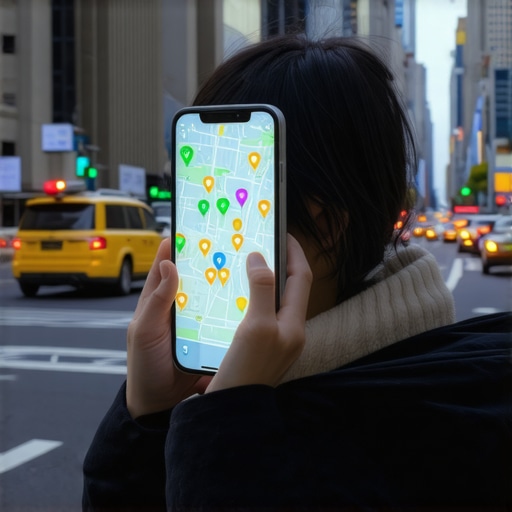
Why Local Rankings Can Vary WILDLY Based on Your Phone’s Location
The smell of wet concrete always reminds me of a job site where a contractor lost everything because of a digital glitch. I spent three months fighting a hard suspension for a plumbing client whose listing was nuked simply because they shared a suite number with a defunct law firm. Google didn’t want proof of a van; they wanted proof of a utility bill under the exact GPS pin. This is the microscopic reality of the local search layer. It is a spatial database where your physical coordinates carry more weight than your website code. When you stand on one street corner, you see a specific set of businesses. Walk fifty feet to the left and the map reshuffles. This variance happens because Google prioritizes proximity over almost every other signal. If you find your phone showing different results than your office desktop, you are witnessing the Vicinity algorithm in real time. This system is engineered to serve the most immediate solution to a mobile user. It ignores the quality of your content if a competitor is physically closer to the searcher’s current latitude and longitude. Success in this ecosystem requires understanding that your business is a beacon. If that beacon is obscured by bad data or historic spam, your visibility vanishes. Most business owners think the map is static. It is not. It is a shifting, breathing grid of intent and distance.
The ghost in the GPS coordinates
Local rankings fluctuate based on mobile coordinates because Google uses a distance-weighted signal that prioritizes the physical proximity of the user over traditional search relevance. This means a business three blocks away will outrank a superior business five miles away for almost every high-intent local query. The algorithm calculates the centroid of the search intent. If you are searching for a locksmith, the radius is tight. If you are searching for a specialized surgeon, the radius expands. I have seen rankings drop simply because a city installed a new median that changed the driving time. Google tracks the movement of phones. It knows how long it takes to get from point A to point B. If your business is technically closer but harder to reach due to traffic patterns, you might lose the top spot. This is why why your local search ranking toolkit is failing the proximity test if it only checks from one fixed point. Real-time tracking requires a grid of data points. You need to see how you perform at the park, the mall, and the suburbs simultaneously. The pin moves. The rankings follow. You cannot hide from the math of the map.
“Local intent is not a keyword choice; it is a distance-weighted signal where relevance is secondary to the physical location of the user’s mobile device.” – Map Search Fundamental
Why your physical address is a liability
Your business address can become a liability if it is located in a high-density area with heavy competitor overlap or if the location has a history of map spam. Google maintains a forensic record of every address. If your office was previously occupied by a lead generation farm, your new profile starts with a trust deficit. We see this often in shared office spaces. When twelve different ‘consultants’ all use Suite 200, the algorithm filters out the duplicates to avoid cluttering the results. This is the ‘Opossum’ filter effect. It hides businesses that are too close to each other geographically to provide a diverse user experience. If you are struggling with this, you might need the audit strategy for uncovering ghost listings that hurt your seo to see who is crowding your space. I once worked a case where a legitimate roofing company was hidden because a fake listing was registered at the utility pole across the street. We had to file a manual redressal to clear the air. A clean physical footprint is the foundation of local trust. Without it, your digital efforts are wasted on a filter you cannot see.
The three mile radius that determines your revenue
The three mile radius is the primary battleground for local service businesses because searchers rarely look beyond the initial map pack for immediate needs. Within this circle, every review and every photo carries triple the weight. If a customer takes a photo at your shop, the GPS metadata in that image tells Google that your location is a destination. This is an interaction signal. It proves you exist in the real world. Many agencies ignore this and focus on backlinks. Backlinks are fine, but they do not prove a van is parked at a specific house. If you are seeing a decline in leads, look at winning back the local leads you lost to proximity changes before you change your website. The algorithm is tightening the circle. In 2025, the ‘hyper-local’ layer is where the money is. You need to dominate the blocks you can walk to before you worry about the next town over. This is the law of the local centroid.
How gmb ranking toolkits work for local seo
GMB ranking toolkits work by using a network of proxy servers to simulate searches from specific GPS coordinates across a defined geographic grid. These tools do not just check ‘Chicago.’ They check 100 different points within Chicago to show you where your visibility starts and stops. This data is vital for understanding your ‘ranking bubble.’ If you see a green circle on your shop and red circles two miles away, you have a proximity problem. You might need to how to audit your competitors using advanced gmb toolkits to see how they are stretching their reach. Some competitors use ‘point of interest’ keywords in their reviews to trick the system. Others use heavy image uploads. A good toolkit reveals these patterns. It shows you the math behind the curtain. Without a grid-based view, you are flying blind. You think you are number one because you are standing in your own lobby. The customer at the coffee shop down the street sees a different reality. Tools bridge that gap. They provide the forensic evidence needed to adjust your strategy.
Local Authority Reading List
- Software that actually helps you outrank nearby competitors
- The agency tool comparison for real-time local map tracking
- Why most map ranking tools give you fake data
- Using heatmaps to track your local search coverage
Local seo services for cleaning historic citation spam campaigns
Historic citation spam cleaning services are required when old, inaccurate, or low-quality business listings dilute your local authority and create brand confusion. Many businesses hired ‘cheap’ agencies years ago that blasted their name across thousands of dead directories. These ghost citations now act as anchors. They pull down your trust score. When Google sees your address as ‘Street’ in one place and ‘St.’ in another, it loses confidence in your location. You must engage in the citation cleanup method that actually recovers lost map rankings to fix this. It is a manual, grueling process. We have to contact webmasters and submit removals. We have to scrub the web of every ‘Suite B’ that should be ‘Suite 200.’ This is not about building new links. It is about removing the rot. A clean profile ranks better than a cluttered one every single time. It is like cleaning the lens of a camera. Suddenly, the image is sharp. The algorithm sees you clearly. The phone starts ringing again.
Services to fix over optimized anchor text
Over optimized anchor text services focus on neutralizing aggressive keyword-stuffed links that trigger spam filters and suppress your local map rankings. If your backlink profile is 90 percent ‘best plumber in New York,’ Google knows you are manipulating the system. Real people link to your brand name or your website address. They do not link using perfect SEO phrases. To fix this, we have to diversify your anchor profile. We use scrubbing the past a simple guide to fixing old seo footprints to identify the danger zones. We reach out to site owners to change the text. We build new, natural links to dilute the poison. It is a balancing act. You want the authority without the penalty. In the local world, brand signals are safer than keyword signals. If your name is ‘Joe’s Plumbing,’ that is what people should call you. If you try to name yourself ‘Best Plumbing 24/7 Service NYC,’ you are asking for a suspension. The map values authenticity. Stick to the brand.
Buy local seo tools for gmb
Buying local SEO tools for GMB provides you with the raw data necessary to track proximity shifts and monitor competitor category changes in real time. These tools are your eyes and ears on the street. They can alert you the moment a competitor changes their primary category from ‘Restaurant’ to ‘Italian Restaurant.’ This small shift can change the entire map pack. You need a a no-nonsense toolkit for gmb keyword and category research to stay ahead. Do not buy tools that promise ‘automated rankings.’ Buy tools that provide transparency. You want to see the heatmaps. You want to see the review velocity. You want to see the specific JSON-LD attributes that your rivals are using. Knowledge is the only advantage in a crowded market. If you have the data, you can make the move. If you are guessing, you are losing money.
“Proximity is the most difficult signal to overcome because it is the only one the business owner cannot change without moving their office.” – Local Search Intelligence Report
Tools to fix low gmb rankings
The most effective tools to fix low GMB rankings are those that identify structural data errors, category mismatches, and user-interaction gaps. A low ranking is often a symptom of a deeper issue. Maybe your business hours are inconsistent across the web. Perhaps you are missing a crucial sub-category that defines your services. Using the audit we use to find gmb ranking gaps in minutes can save you months of frustration. We look for ‘latent errors.’ These are things like a broken website link in a third-tier citation or a mismatched phone number on a Yelp page. These small things aggregate into a large trust problem. Fix the data, and the ranking usually follows. You do not need magic. You need maintenance. Keep your profile sharp. Post regularly. Respond to every review. These are the tools of a professional.
Seo services to fix brand confusion from merged gmb listings
Brand confusion services for merged GMB listings involve disentangling conflicting data points and restoring the unique identity of each physical location. This often happens after an acquisition or a relocation. Two profiles get merged by the algorithm, and suddenly your reviews for the downtown office are showing up for the suburban branch. It is a disaster for local trust. You need the tactics for recovering from a merged gmb listing disaster to separate them. This requires working with Google Support and providing distinct evidence for each site. You need separate utility bills, separate signage photos, and separate phone lines. The algorithm wants to see two different entities. If they look the same, they get merged. Clarity is your friend. Make sure every location has its own story, its own photos, and its own voice. This is how you win the multi-location game.
How gmb ranking toolkits work for local seo
GMB ranking toolkits function by scraping the Google Maps API and front-end search results from thousands of virtual locations to map out your geographic influence. They provide a ‘topographical’ view of your SEO. You can see the ‘hills’ where you rank number one and the ‘valleys’ where you are invisible. This helps you decide where to focus your marketing. If you are weak in the north, maybe you need more customer reviews from people living in that area. If you are strong in the south, you can defend that territory. Check why your current ranking toolkit fails to beat local competitors if you aren’t seeing this level of detail. A tool is only as good as the data it collects. If it only checks once a week, it misses the daily fluctuations of the map. You need real-time intelligence to compete in 2025.
Local seo toolkit for google maps ranking
A comprehensive local SEO toolkit for Google Maps ranking must include a citation manager, a review solicitor, and a spatial heatmap generator. These three components cover the core pillars of local search: Prominence, Relevance, and Proximity. Prominence is how well-known you are. Relevance is how well you match the search. Proximity is how close you are. You should use the map pack toolkit that found our competitors hidden advantage to see which of these pillars your rivals are leaning on. Some rely on thousands of photos. Others have a massive lead in local reviews. Once you know their strategy, you can counter it. It is like a game of chess played on a city map. Every move matters. Every photo counts.
Local seo toolkit for multi location businesses
The ideal toolkit for multi-location businesses centralizes data management to ensure that every branch maintains consistent NAP information and localized content. Managing ten locations is hard. Managing a hundred is impossible without automation. You need a dashboard that shows you every location at a glance. You need the multi-location toolkit for serious local growth to prevent errors from cascading across your brand. If one manager changes the hours on one profile, it must be reflected everywhere. Inconsistency is the number one killer of multi-location rankings. Google sees a mismatch and loses trust in the entire brand. Keep it tight. Keep it uniform. But keep it local. Each page should still mention the neighborhood it serves. That is the secret to scaling.
Top google business profile seo toolkits
The top Google Business Profile SEO toolkits are those that integrate directly with the API to provide verified insights into impressions, clicks, and phone calls. Do not trust third-party estimates. You want the real data from the source. Look for tools that allow you to schedule posts and monitor ‘suggested edits’ from users. Competitors will often try to change your phone number or mark your business as ‘closed.’ A top-tier tool will alert you immediately so you can reject the change. Check out 5 specific tools that help your google business profile rank without the fluff for a curated list of what actually works. You don’t need a hundred features. You need five that work every time. Spend your budget on data, not on shiny interfaces.
Local seo checklist and toolkit for gmb
A successful GMB checklist includes verifying primary and secondary categories, uploading weekly geo-tagged photos, and responding to every user question within twenty-four hours. This is the daily grind of local search. It is not a set-it-and-forget-it system. You need to be active. Use a realistic toolkit for managing local brand consistency to stay on track. If you stop posting, your profile goes cold. If you ignore reviews, your conversion rate drops. The map rewards the businesses that are most ‘alive.’ Show Google that you are open, active, and helpful. Upload a photo of your team. Share a video of your office. Answer a question about parking. These small interactions build the trust signal that keeps you in the top three. The pin is just a starting point. Your activity is what keeps it there.