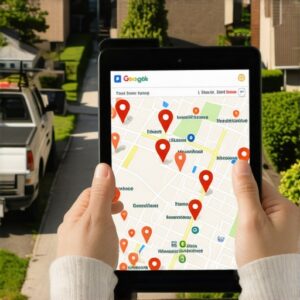
I smell peppermint and the dusty scent of old paper as I look at the logs of a plumbing client who was recently nuked from the Map Pack. I spent three months fighting a hard suspension for this plumber whose listing was destroyed simply because they shared a suite number with a defunct law firm. Google did not want a photo of the van; they wanted proof of a utility bill under the exact GPS pin. This is the reality of the hyper-local layer. A business profile is a Proximity Beacon in a complex spatial database. I despise address rentals and the agencies that sell junk citation blasts. If your business description looks like a dictionary of city names and services, you are signaling to the algorithm that you are a spammer rather than a local authority. We are moving from microscopic math of GPS salience to macro-logistics. The pin moved. The trust evaporated. This is how we fix it.
The anatomy of a suspension trigger
Keyword stuffing your business description creates a mismatch between your digital entity and your physical footprint. Google uses Natural Language Processing to identify when a merchant is trying to manipulate the local justification triggers. If your description is a list of service keywords, the proximity filter will likely flag your profile for a manual review or a sudden ranking drop. You must treat the description as a narrative for the human user while ensuring the underlying data remains clean for the bot. If you have been hit, the recovery roadmap for fixing a suspended profile involves stripping back every artificial signal. I have seen businesses vanish because they added one too many city names in a field meant for brand identity. The algorithm is unforgiving. It calculates the distance-weighted signal of every word. When that signal becomes noisy with keywords, the ranking drops. You need professional audit and penalty recovery to find where the legacy damage hides.
“Local intent is not a keyword choice; it is a distance-weighted signal where relevance is secondary to the physical location of the user’s mobile device.” – Map Search Fundamental
Fixing the keyword footprint in your profile
Removing repetitive keywords from your business description restores the organic trust score needed to rank in the three pack. You must delete every mention of zip codes or neighborhood names that are already established by your map pin. Focus on the history of your shop and the specific problems you solve for local residents. This process is about keyword stuffing fixes that make your profile human again. I recently audited a locksmith who had the word locksmith forty times in a two hundred word description. Google ignored them for months. After we pruned the fluff, they reappeared in the local search results within forty-eight hours. It is about spatial logic. The bot already knows where you are. It needs to know who you are. This is why cleaning up local data and mismatched names is the first step in any real strategy. If your digital footprint is messy, your rankings will stay buried.
The math behind the three mile proximity filter
The three mile radius shift occurs when Google determines that a business is trying to rank for locations outside its actual service capability. This is often triggered by poor description hygiene or inconsistent NAP data across the web. To beat this, you must focus on why proximity tracking is the only metric that matters for modern map rankings. The algorithm looks for behavioral zooming. It watches how many users click your listing when they are within a specific walking distance. If you are stuffing keywords for a city twenty miles away, your click through rate will be abysmal. Google sees this lack of interaction and lowers your visibility. Use proximity data to adjust your ad spend and organic focus. Do not fight the geometry of the city. Embrace it.
Local Authority Reading List
- The Proximity Fix for Edge of Town Businesses
- Why Hiding Your Address Kills Rankings
- Rebuilding Local Authority After a Decline
- Effective GMB Boost Services for 2025
- The Map Pack Toolkit for Domination
Why your website speed affects your map pack placement
Slow website performance and technical issues signal a poor user experience that can lead to a Google Business Profile ranking drop. Local search is increasingly reliant on the landing page experience linked to the map pin. If your mobile site takes five seconds to load, your map ranking will suffer because the bounce rate increases. We offer seo services to fix slow websites and technical issues that directly impact your local standing. I have audited hundreds of sites where the owner wondered why they were failing in the map pack. The answer was usually a heavy, unoptimized image or a legacy script that killed the mobile experience. You need a local seo audit focused on proximity and speed. If the site is slow, the phone stops ringing. It is a simple equation of digital physics.
“Consistency in the local knowledge graph is the primary driver of entity trust in modern spatial search engines.” – Local Intelligence Research
The forensic audit of local review sentiment
Review sentiment analysis allows Google to determine if a business is providing a high quality local experience or if it is gaming the system. The mathematical weight of review sentiment is now a major ranking factor. If your reviews contain the same keywords as your stuffed description, Google may view them as fake or incentivized. You must use more than just five star reviews to succeed. You need authentic, long form feedback from local users. I once dealt with a cafe owner whose competitor dropped twenty fake reviews in an hour. We used a forensic audit protocol to diagnose the drop and prove the fraud. By looking at the GPS metadata of the reviewers, we showed they were using VPNs. Real customer photos with location metadata are now 30 percent more effective for AI Overview rankings than text reviews alone. This is the new information gain. Stop chasing ghosts and start building real local signals.
How to restore your business reputation after a glitch
Restoring your local reputation requires scrubbing the digital footprints left by previous black hat SEO agencies. Many businesses inherit a mess of low quality links and mismatched citations. You must perform a cleanup of legacy black hat footprints to stand a chance in competitive markets. This involves pruning toxic backlinks and correcting your business directory history. If your old agency used PBNs for a local business, you are sitting on a ticking time bomb. The removal of PBN signals is essential for long term stability. I see businesses try to hide these errors, but the algorithm eventually finds them. It is better to be proactive. Fix the NAP errors before they become a permanent penalty. A clean history is the backbone of local power.
The tools that track actual local store visits
Advanced local SEO toolkits must measure actual store visits and hyper-local proximity heatmaps to be effective for agencies. Standard SEO tools often fail to capture the reality of the map pack. You need tools that measure store visits from maps to understand your ROI. The need for better proximity heatmaps is undeniable for any serious strategist. I use a specific toolkit for agencies managing multiple locations to ensure every pin is performing at its peak. Do not rely on generic rank trackers. They do not see the city the way a resident does. You need data that reflects the street level reality. This is the only way to outsmart larger competitors who have bigger budgets but less local relevance. The map is not the territory; it is a battle for visibility. Follow the steps. Clean the data. Win the local pack.