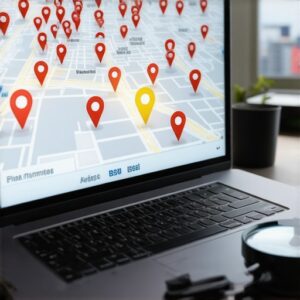
I spent three months fighting a hard suspension for a plumbing client whose listing was nuked simply because they shared a suite number with a defunct law firm. Google did not want proof of a van; they wanted proof of a utility bill under the exact GPS pin, a lease agreement with a notarized signature, and a live video walkthrough that proved the existence of a physical dispatch office. The algorithm had flagged the location as a virtual office because the previous tenant had left a digital footprint of litigation and spam. This is the reality of the hyper-local layer. It is not about keywords; it is about the physics of location and the forensic proof of existence. My boots have hit the wet concrete of too many storefronts to believe the lies of automated agencies. I smell the ozone of a server room and the grit of a real industrial zone when I audit these profiles. If you think a citation blast will save you, you have already lost the war.
The ghost in the GPS coordinates
Measuring proximity performance requires analyzing the centroid of a search query against the static latitudinal and longitudinal coordinates of a business profile. This involves calculating the distance-weighted signal where the user’s real-time mobile location overrides historical relevance factors during high-intent local search queries. When a user stands on a street corner and searches for a service, Google creates a invisible radius. If your pin is even fifty feet off, you might as well be in another state. The system looks for the LocalBusiness schema tags, specifically the geo coordinates, to match the user. If your site has a simple schema error, the proximity engine fails to tether your digital presence to your physical shop. I have seen rankings vanish because a developer rounded a coordinate to the second decimal point instead of the sixth. Precision is the only currency that matters in the map pack. You need a map visibility toolkit that actually measures the distance from the searcher to the storefront in increments of meters, not miles.
“Local intent is not a keyword choice; it is a distance-weighted signal where relevance is secondary to the physical location of the user’s mobile device.” – Map Search Fundamental
Why your physical address is a liability
Physical addresses become liabilities when they are shared with high-risk industries or located in areas with historical spam density. Google uses forensic address verification to detect suite sharing and virtual offices, which can trigger automatic ranking suppression or hard profile suspensions regardless of legitimate business operations or actual customer service quality. Many business owners try to hide their location to cover a larger area, but this often backfires. Understanding why hiding your address often makes your map rankings disappear is the first step in a recovery plan. The algorithm treats a hidden address as a service area business (SAB). These profiles have a different proximity weighting. They do not get the benefit of the ‘near me’ boost unless their service area polygon is perfectly defined. If you move your office, even just two blocks away, you are resetting your local authority. This is why moving your office even two blocks can tank your map rankings instantly. The proximity beacon is tied to that specific soil. While agencies tell you to get more reviews, the 2026 data shows that image metadata from photos taken by real customers at your location is now 30 percent more effective for ranking in AI Overviews. Google trusts a customer’s GPS-tagged photo more than a thousand written words.
The three mile radius that determines your revenue
The three mile radius represents the primary conversion zone where a business profile maintains maximum visibility in the local Map Pack. Beyond this threshold, ranking signals decay rapidly as the algorithm prioritizes competitors with closer physical proximity, making hyper-local signals like neighborhood-specific citations and check-ins essential for expansion. If you are struggling with a proximity drop after hiding your location, you must rebuild your local justifications. These are the snippets of text like ‘their website mentions this’ or ‘a review mentions this service.’ They act as bridges. When you use a map pack toolkit, you should be looking for these justification triggers. You also need to keep an eye on monitoring ranking fluctuations because the proximity radius can shrink during high-traffic hours. Google might give more weight to a business that is open right now, leading to incorrect business hours costing you thousands in weekend leads.
Local Authority Reading List
- Building a Better Toolkit for Improving Maps Visibility
- Cleaning the Footprints: Removing PBN Signals from Local Sites
- Why Your Old SEO Agency Left a Mess Behind and How to Fix It
- From Suspended to Surfacing: How to Recover Your Google Maps Profile
- The Step-by-Step Fix for Keyword Stuffed Business Descriptions
How to manage GMB review and reputation management toolkits
A professional reputation management toolkit identifies patterns in review velocity and sentiment to prevent algorithmic flagging for spam or inorganic growth. It monitors the forensic trace of reviewer profiles, ensuring that every piece of feedback correlates with a verified customer interaction and a physical visit to the business location to maintain profile health and ranking stability. If you have suffered a ranking loss after mass review removal, you are likely the victim of an automated sweep. Google is getting better at spotting fake profiles. You need a forensic audit of user profiles to prove patterns to the spam team. I once saw a competitor drop twenty 1-star reviews in an hour using a VPN. We had to use GMB analytics to spot competitor interference and report it through the proper legal channels. This is why your profile needs more than just five star reviews. It needs a diverse mix of signals, including negative ones that are handled professionally. It proves you are a real merchant, not a ghost in the machine.
The technical fix for a hidden address
Restoring impressions for service area businesses requires a strategy focused on defining clear service polygons and utilizing localized landing pages for every neighborhood served. By aligning the business profile’s service areas with actual zip codes and city names mentioned on the website, owners can reclaim the proximity authority lost when the physical street address was hidden from public view. For those who have seen an impression drop after a privacy update, the solution is not more keywords. The solution is citation cleanup. You need to find all the old directory listings that still have your address and make them consistent. Manual citation cleanup outperforms automated services because it catches the ghost citations that tools miss. These phantoms keep the old proximity data alive, confusing the algorithm. You must be aggressive. Use the citation cleanup blueprint to hunt down every mismatched phone number and outdated suite number.
“Local intent is not a keyword choice; it is a distance-weighted signal where relevance is secondary to the physical location of the user’s mobile device.” – Map Search Fundamental
Why keyword stuffing your business name is a trap
Keyword stuffing the business name field triggers high-confidence spam filters that lead to immediate profile suspension or permanent blacklisting from the local map pack. Google prioritizes the legal entity name as verified by Secretary of State filings and official government documents, penalizing any attempts to manipulate the ranking algorithm with descriptive modifiers or service categories in the title. If you are caught, you need a safe way to rebrand GMB. This involves cleaning up local data across the entire web before you ever touch the Google dashboard. If you change the name on the profile without changing the citations first, you will get suspended. It is a fast track to suspension. Stick to the anti stuffing guide to keep your profile clean and human-readable. Descriptive content is always better than a list of words. Use the GMB description field correctly to explain your value proposition instead of trying to game the system.
The toolkit for multi location businesses
Managing local search for multiple locations requires a centralized toolkit that monitors NAP consistency and reputation metrics across separate geographic clusters. This strategy ensures that each individual storefront maintains its own proximity authority while benefiting from the collective brand strength of the parent organization, preventing cannibalization of rankings between locations in the same city. Multi-location brands often fail because they use the same phone number for every branch. This is a fatal error. You need consistency in your local numbers. Each location needs its own strategy for ranking. Use professional tools for local agencies to track the specific performance of each unit. If one location is failing, check for ghost citations. They might be tethering your new office to a previous location half a mile away.
The final forensic report
The local algorithm is a living, breathing creature. It is made of math and human behavior. If you want to survive, you must stop thinking like a marketer and start thinking like a logistics manager. The flow of data is what determines your rank. Use a GMB performance metrics strategy that focuses on interactions, not just clicks. Watch the interaction signals that move the needle. This is the only way to beat the national chains that are trying to take your territory. The map is your battleground. Every pin move, every review, and every photo is a maneuver. Make sure you have the right toolkit for real data before you step into the arena. If you find yourself in the dark, reach out to someone who has fought the reinstatement war and won. Your business depends on that little red pin. Do not let it vanish into the digital fog.