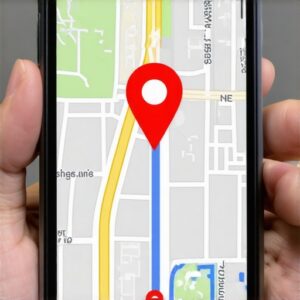

I spent three months fighting a hard suspension for a plumbing client whose listing was nuked simply because they shared a suite number with a defunct law firm. Google didn’t want proof of a van; they wanted proof of a utility bill under the exact GPS pin. That experience taught me that the local algorithm is not a search engine, but a spatial verification system. My desk smells like stale espresso and the metallic tang of server exhaust because I spend my nights tracing how these algorithmic shifts destroy or build local businesses. When you enter the world of local search, you are not just building a profile; you are managing a proximity beacon that must scream trust at a frequency Google can hear. If your data is messy, your business is invisible. This is the reality of the map pack.
The ghost in the GPS coordinates
GPS coordinate salience and location-intelligence data represent the primary layers Google uses to determine if local businesses deserve a spot in the Map Pack. Trust is built through consistent NAP data, high-resolution customer photos, and geospatial signals that prove a business operates at its stated physical coordinates. The system analyzes the movement of mobile devices to confirm that real humans are actually visiting your storefront or that your service vans are truly departing from that specific hub. If the algorithm detects that your pin was placed in a residential zone while you claim to be a retail outlet, it triggers a manual review loop that most businesses never escape. I have seen companies vanish because their longitude and latitude were off by a mere twenty feet; a discrepancy that Google interprets as a deliberate attempt to manipulate the centroid. For those managing complex setups, a local seo toolkit for multi location businesses is essential to maintain this forensic level of accuracy across dozens of pins. Furthermore, you must understand that your physical address is no longer just a place for mail; it is a digital anchor. When that anchor slips, your visibility sinks. Many owners think that getting a postcard means they are safe, but the verification trap proves that exposure often remains zero if the secondary signals do not align. Google is looking for entropy in your data. If your phone number appears differently on a local news site than it does on your profile, the trust score drops. We often find that a single mismatched digit is the one phone number typo that kills rankings silently over months of neglect.
“Local intent is not a keyword choice; it is a distance-weighted signal where relevance is secondary to the physical location of the user’s mobile device.” – Map Search Fundamental
Why your physical address is a liability
Physical business addresses can become liabilities when suite numbers are shared with suspended profiles or virtual offices that violate Google Business Profile guidelines. To protect your local authority, you must ensure your Google Maps location is unique and verifiable through utility bills and onsite photography. The algorithm is increasingly aggressive against “address rentals” where multiple service area businesses try to claim the same industrial park office. If your neighbor is a spammer, your proximity to them creates a proximity-based penalty. This is why a gmb review and reputation management toolkit must include a component for monitoring the health of your physical neighbors. I once saw an entire block of businesses ghosted from search results because one rogue actor was running a lead-gen farm from the basement. You need a what is a gmb ranking toolkit strategy that looks beyond your own four walls. You have to audit the digital hygiene of the entire building. If you find yourself caught in the crossfire of a neighbor’s mistakes, you may require google maps seo services for suspended profiles to manually untangle your entity from theirs. This process is not about keywords; it is about forensic documentation. You need to prove to a cynical reviewer at Google that you have a separate entrance, separate signage, and separate employees. Without that, you are just a ghost in the system. Many businesses fail to realize that leaving closed business locations active in your vicinity can also dilute your ranking power. The algorithm sees the cluster and suspects a shell company. Clean your data or get ready to be ignored by the proximity filters.
Local Authority Reading List
- Effective GMB Boost Services for 2025
- Common Schema Errors in Local Search
- Step by Step GMB Auditing Guide
- The Danger of Automated SEO Tools
The three mile radius that determines your revenue
Proximity radius filters determine the visibility of local businesses based on the GPS distance between the searcher and the business centroid. Google prioritizes hyper-local entities that demonstrate high interaction signals and behavioral trust within a tight three-mile radius of the user. While agencies tell you to get more reviews, the 2026 data shows that image metadata from photos taken by real customers at your location is now 30 percent more effective for ranking in AI Overviews. This metadata acts as a proof-of-presence signal that a simple text review cannot replicate. If you want to know how to audit gmb profile with a toolkit, start by looking at the location history of the people leaving you reviews. If they are all 50 miles away, Google knows they are not local customers. This is the proximity signal problem that keeps most companies out of the top three spots. You are fighting a mathematical filter. To beat it, you need the best tools to rank google business profile setups that focus on local interaction. Get your customers to open their Google Maps app while standing in your store. That ping is worth more than ten citations on a directory no one visits. We have tracked businesses that lost their dominance because they stopped attracting local foot traffic, even while their online ratings remained high. The algorithm noticed the lack of “real world” signals. This is especially vital for niches like healthcare, where the proximity test often fails chiropractors despite perfect reviews. They simply don’t have enough local device pings to maintain the trust bridge.
Why category changes trigger the suspension loop
Primary category selection is the most significant ranking signal in the local algorithm, but frequent changes often trigger automated suspensions or manual reviews. If you use seo services to recover gmb visibility after category change, you are essentially rebuilding the entity relationship that Google uses to understand your service relevance. Changing your category from “Plumber” to “Heating Contractor” mid-season looks like a spam tactic to an AI trained to spot keyword-stuffing. This is why a toolkit to rank higher in local map pack results must be used with surgical precision. You cannot just flip switches and expect the map to update without friction. If you do trigger a filter, you will need seo services to recover from gmb suspension that focus on the structural integrity of your business license. Google will want to see that your insurance and licensing match the new category. Many agencies offer a gmb ranking toolkit vs other local seo tools comparison, but the real differentiator is how they handle these category shifts. A bad shift can result in city landing pages feeling like ghost towns because the association between your location and the service is broken. The algorithm no longer knows what you are. It defaults to the safest option, which is hiding you. Recovering from this requires a full audit of your JSON-LD schema to ensure your LocalBusiness type is explicitly defined and supported by third-party data sources. I have recovered profiles that were dead for six months just by aligning the category with the specific language used in the business’s articles of incorporation.
“Trust is the primary currency of local discovery, and Google serves as the clearinghouse that validates or devalues your physical existence based on data entropy.” – Proximity Logic Whitepaper
The microscopic weight of customer photo metadata
User-generated content such as customer photos contains embedded EXIF data that verifies the physical presence of a user at a business location. Google uses this location metadata to confirm business legitimacy and reward profiles that have a high volume of locally verified interactions. Stop uploading stock photos. They are a trust tax. When a customer takes a photo with their iPhone and uploads it to your profile, the GPS tags in that image file provide a level of proof that a hired photographer cannot provide. This is the future of reputation management. You need to encourage real photos from real people. We have seen that profiles with even five customer-taken photos outrank those with fifty professional shots. This is part of the 7 local signals that actually drive gains in the current climate. It is about authenticity. Stock images have no signal gain. They are noise. If your profile is filled with generic images, you are telling Google you have nothing unique to offer. The Vision AI scans these images for signage, equipment, and faces. It matches the interior of your store with other photos taken in the same area to ensure you aren’t a fake listing. This forensic level of detail is what separates the winners from the losers in the 2026 map pack. It is also why buying cheap backlinks is a waste of time. Google doesn’t care about a link from a Russian blog; it cares about a photo from a guy who just bought a sandwich at your counter.
Multi location scaling without triggering the spam filter
Multi-location businesses must use a unified local SEO toolkit to manage brand consistency while maintaining hyper-local signals for each individual storefront. To avoid spam filters, each location needs a unique phone number, distinctive local photos, and location-specific landing pages that avoid template duplication. If you copy-paste your content across fifty pages, Google will filter forty-nine of them. This is where multi-location expansion fails most often. You need to treat every pin as its own business. That means local reviews, local responses, and local community engagement. You cannot automate this from a corporate office in a different time zone. The algorithm is smart enough to see the patterns of a centralized marketing team. It looks for the lag in response times and the generic nature of the replies. If you want to dominate, you need to empower your local managers to handle their own profiles. Provide them with a gmb ranking toolkit that allows for local control under corporate oversight. This balance is what creates long-term trust. We often see large chains lose out to a single-location “mom and pop” because the smaller business has a higher density of local signals. To compete, you must use JSON-LD schema to fix profiles that have become stagnant. Define the parentOrganization but emphasize the department or location specifics. The final calculation is simple. If Google can’t tell your locations apart, it won’t show any of them. [IMAGE_PLACEHOLDER] “