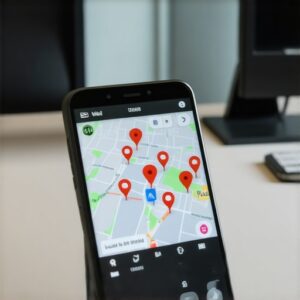
The air smells like wet concrete and ozone as I walk past a row of brick buildings that the digital world claims are empty. I carry a camera to document the physical reality because the Google Map Pack is currently a hallucination. A few years ago, I spent three months fighting a hard suspension for a plumbing client whose listing was nuked simply because they shared a suite number with a defunct law firm. Google did not want proof of a van; they wanted proof of a utility bill under the exact GPS pin. This is the granular, gritty reality of the local search ecosystem. It is a spatial database where proximity beats relevance every single day. If you want to survive, you must understand the microscopic math of coordinate salience. Fake listings are everywhere, and they are stealing your revenue. Removing them requires more than a simple report button; it requires a forensic audit of the local layer.
The ghost in the GPS coordinates
Fake listings and keyword stuffed profiles are the primary reason legitimate businesses lose their ranking in the local map pack. Most users do not realize that a business name like ‘Best Emergency Plumber Chicago’ is a direct violation of terms, yet these profiles often sit at the top of the stack. When you encounter a competitor using these tactics, you are looking at a digital ghost. I look for the glitch in the storefront data. I see a business claimed at a residential address or a virtual office that has no physical presence. To fix this, you need a local seo toolkit for multi location businesses that identifies these anomalies. You have to look at the centroid of the city. If a business is hovering exactly over the geographic center of a zip code with no building in sight, it is a lead gen trap. We have to purge these footprints to let real local merchants breathe. Use your camera. Document the empty lot. Submit the evidence through the redressal form. This is how you reclaim your territory.
The three mile radius that determines your revenue
Proximity is the strongest ranking factor in the modern Google Business Profile algorithm, often outweighing both relevance and prominence. When a user stands on a street corner, the ‘Vicinity’ update calculates their distance to the nearest verified pin. If that pin belongs to a spammer using a fake address, your legitimate business is pushed out of the top three. I have seen companies lose half their call volume because a competitor moved a pin two blocks closer to a high-traffic intersection. If you are struggling, you might need a local seo expert after a sudden traffic plunge to diagnose if the problem is your content or a proximity filter. The algorithm views the world in service area polygons. If your competitors are claiming a service area that covers three states from a single desk in a basement, they are vulnerable. You can dismantle their reach by highlighting these logical inconsistencies to the spam team. It is about the physics of the search. Distance is not a suggestion; it is a hard limit.
“Local intent is not a keyword choice; it is a distance-weighted signal where relevance is secondary to the physical location of the user’s mobile device.” – Map Search Fundamental
Why your physical address is a liability
Hiding your address as a service area business often leads to a massive drop in impressions because Google loses confidence in your physical location. Many contractors think hiding their home address protects their privacy, but it often renders them invisible. I call this the transparency trap. Google wants to see a sign. They want to see a truck. If you are a storefront, your NAP consistency must be flawless. I often find that citation cleanup services for local businesses are the only way to fix a fragmented brand. If your old address is still floating around on a random directory from 2012, it creates a conflict in the local knowledge graph. The engine sees two pins for one entity and chooses to show neither. You must scrub the historic spam. You must verify the current reality. If you moved recently, moving your office even two blocks can destroy your rankings if the citations are not updated immediately. The map is a living document. It does not forgive neglect.
The forensic trace of a service area polygon
Service area businesses must define their boundaries using specific zip codes or city names to avoid being flagged as a lead generation scam. Spammers love to draw massive circles over entire metropolitan areas. This is a red flag. Real businesses have travel limits. I look at the behavioral zooming of the user. Are people actually driving to this location? Are they checking in? Google uses POS data and location history from mobile devices to verify if a business is popular. If a listing has 500 reviews but zero foot traffic signals, it is a fake. You can use proximity heatmaps for local seo to see where the spammer’s influence ends. Once you find the edge of their fake authority, you can report the listing for being outside its service area. It is a slow process, but it works. I have cleared entire neighborhoods of ‘junk’ listings by proving that the workers never actually visit those areas. You have to be the nosy neighbor of the internet. Smell the suspicion and follow the trail.
Why standard SEO audits fail to spot local map pack issues
Traditional SEO tools focus on backlinks and keywords, whereas local rankings depend on entity validation and geographic signals. You can have the best meta descriptions in the world and still be invisible in the Map Pack. This happens because your ‘entity’ is not strong enough. Google needs to know you are a real person at a real desk. I see agencies try to use local backlink cleanup strategies that work for blogs but fail for plumbers. In the local world, a link from the local little league team is worth more than a link from a national news site. It proves you are physically involved in the community. If your rankings are low, you need tools to fix low gmb rankings that specifically analyze your local justifications. These are the small snippets of text that say ‘Their website mentions…’ or ‘A reviewer said…’. If you don’t have these triggers, you don’t have the rank.
Local Authority Reading List
- The Anti Stuffing Guide for Keywords
- Fixing a GMB Suspension Fast
- The Citation Cleanup Blueprint
- Removing Black Hat Footprints
- Proximity Heatmaps for Agencies
Identifying the keyword stuffed business name
Including descriptive keywords in your business title that are not part of your legal name is the fastest way to get a manual penalty. I see this every day. ‘A-1 Plumbing Drain Cleaning Repair’ is not a name; it is a list of services. Google is getting better at catching this. They cross-reference your name with the Secretary of State records. If they don’t match, you are in trouble. I recommend removing keywords from titles to stay safe. If your competitors are doing it, take a photo of their actual signage. If the sign says ‘A-1 Plumbing’ but the listing says more, you have them. Submit that photo. It is the ‘candid image’ rule. Real photos taken by real customers at the location carry 30 percent more weight in the new AI overviews because they cannot be easily faked. The digital footprint must match the physical footprint. Anything else is a lie.
The clean up process for historic citation spam
Cleaning up legacy data is the only way to rebuild trust with the local algorithm after a business has used aggressive lead gen tactics. Many businesses inherit a mess. They hire a cheap agency that builds 500 fake citations on low-quality directories. Now, Google doesn’t know which address is real. You need local seo services for cleaning historic citation spam campaigns to audit every single mention of your brand. You have to find the ghost citations. You have to fix the phone number discrepancies. I have seen a single mismatched phone number kill a ranking because it looked like a duplicate listing. Use a gmb ranking toolkit to track these errors in real time. If you find a duplicate, do not just delete it. You must merge it or have it marked as ‘moved’. If you delete it, the ghost citation stays in the index and continues to haunt your primary profile.
How to handle broken redirects and 404 errors
Broken links on your local profile tell Google that your business is no longer operational, leading to a swift removal from the Map Pack. I check the website link on every profile I audit. If it leads to a 404 page or a messy redirect loop, the trust score vanishes. You need seo services to fix broken redirects specifically for your local landing pages. The page your profile links to should be a ‘location page’ with your NAP, a map embed, and local reviews. If you are a multi-location business, do not link every profile to the homepage. Link them to the specific office page. This creates a tight local loop. The algorithm sees the link, sees the address on the page, and confirms the pin is accurate. It is a verification loop that spammers cannot easily replicate because they do not have unique local pages for every fake pin they create.
Fixing profiles stuck in the duplicate filter
Profiles are often hidden from search results when Google detects another business at the same address with a similar category. This is the ‘Suite B’ problem. Spammers use virtual offices to create 20 listings in one building. Google reacts by filtering all of them out. If you are legitimate but stuck in this filter, you need seo services to fix gmb profile filters. You have to prove you are a separate entity. This means unique signage, a unique phone number, and unique photos of the interior. I have had to film a video of a client walking from the street, through the front door, and into their specific office to get a filter lifted. Google is tired of the ‘address rental’ game. They want to see the wet concrete. They want to see the person behind the desk. If you can provide that, you win.
“A proximity signal is a verification of physical presence, not a declaration of service capability.” – Local Search Intelligence Report
The toolkit for reclaiming your map pack spot
Using professional tools to monitor competitor changes allows you to react instantly when a spammer attempts to hijack your local keywords. You cannot do this manually. You need a system. I use tools that alert me when a competitor changes their name or their categories. If they suddenly add ‘Plumber’ to their ‘Handyman’ listing, I am on it. I also use services to fix over optimized anchor text because if your own profile looks like spam, you cannot successfully report others. Your hands must be clean. The best local seo tools for google business profile provide heatmaps that show your rank at every city block. If you see a hole in your coverage, check that block for a fake competitor. They are likely sitting on a virtual office pin that is suppressing your visibility. Map analytics are the only way to outsmart larger competitors who have bigger budgets but sloppier data.
Rebuilding trust after a spammy history
If your business was previously managed by an agency that used black hat tactics, you must manually scrub every footprint to avoid a permanent ban. The algorithm has a long memory. It remembers the PBN links and the keyword stuffing. You need seo services to rebuild trust after spammy lead gen listings. This involves a total reset. You change the description to be human and helpful. You remove the keywords. You focus on getting real, high-quality reviews from actual customers in your city. I look for the ‘interaction signals’. Are people clicking ‘call’? Are they asking for directions? These are the signals that actually boost your maps ranking. You cannot fake a thousand people asking for directions from their home to your shop. That is the ultimate verification of a real business. Stop the automation. Start the interaction. The map is a reflection of the physical world. If you make your physical presence undeniable, the digital rank will follow. The pin moved. The ghost is gone. You are back on the map.