
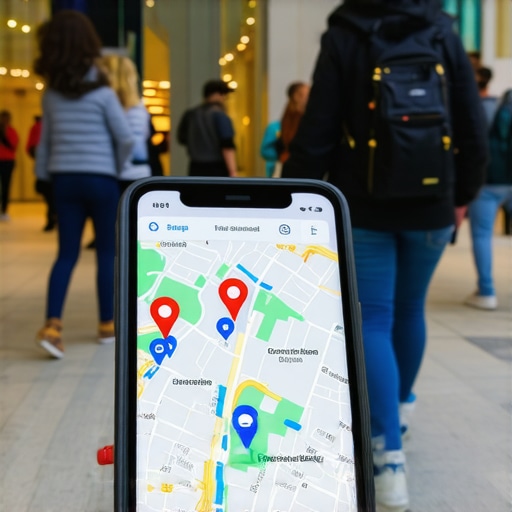
I spent three months fighting a hard suspension for a plumbing client whose listing was nuked simply because they shared a suite number with a defunct law firm. Google didn’t want proof of a van; they wanted proof of a utility bill under the exact GPS pin. I remember the smell of wet concrete as I stood outside their warehouse, taking photos of the brickwork to prove the physical existence of the business. The digital landscape is unforgiving to those who do not understand the math of the proximity beacon. Converting views into visits is not about keywords. It is about the forensic verification of spatial data.
The ghost in the GPS coordinates
Local Business entities must prioritize coordinate salience and verified map pins to appear in the Map Pack. Converting Google Business Profile views requires interaction signals such as requesting directions or calling directly from a mobile device located within a specific geographic radius. The algorithm does not care about your intentions; it only tracks the physical flow of mobile units. If your pin is off by twenty feet, you are invisible. This is why a proximity glitch can ruin a high-performing merchant overnight. I see the glitches in the storefront data every day. A misspelled street name or a missing suite number creates a digital ghost. These ghosts confuse the crawler. When the crawler is confused, the Map Pack rank drops. You need a toolkit to rank higher in local map pack that focuses on the physical reality of your location.
“Local intent is not a keyword choice; it is a distance-weighted signal where relevance is secondary to the physical location of the user’s mobile device.” – Map Search Fundamental
The three mile radius that determines your revenue
Proximity-weighted signals limit local maps visibility to a tight geographic circle around the searcher’s location. Businesses must optimize for neighborhood-specific searches and hyper-local intent to capture high-intent leads and drive in-store traffic. The pin moved. That is all it took for the plumber to lose forty percent of his revenue. We are living in a world where the centroid of a city no longer dictates the winner. The algorithm now favors the closest credible answer. To compete, you must understand [how to measure your true maps proximity without biased tracking](https://gmbvisibilityservice.com/how-to-measure-your-true-maps-proximity-without-biased-tracking). If you are using a virtual office, you are already losing. Google tracks the movement of phones into and out of those buildings. If no one is actually working there, the profile is a lie. That is why [seo services to fix gmb issues caused by virtual office or coworking space](https://gmbvisibilityservice.com/why-your-verified-business-still-doesnt-show-up-for-nearby-customers) are in such high demand. They are cleaning up the mess left by lazy marketers who thought they could rent their way to the top of the map.
The forensics of penalty recovery
SEO services to recover from google penalty require a deep audit of citation consistency and GMB profile history. Recovery is achieved by removing duplicate map listings and correcting incorrect business information online to restore algorithmic trust and map visibility. I once audited a cafe owner who had twenty different addresses listed on the web because of an old franchise agreement. The system saw it as a massive map-spam attempt. We had to engage in a citation cleanup for local businesses that took months of manual outreach. It was like scrubbing graffiti off a limestone wall. You cannot automate this. If you use a bot, you leave a trace. Google looks for that trace. If you find your [gmb exposure is flatlining despite hiring a visibility service](https://gmbvisibilityservice.com/why-your-gmb-exposure-is-flatlining-despite-hiring-a-visibility-service), it is likely because the spam filter has flagged your profile.
Local Authority Reading List
- Is your visibility service actually improving the map pack or just sending reports
- The free tools we use to spot google business profile ranking gaps
- 7 local signals that actually drive maps visibility gains
- The interaction signal audit most gmb boost services completely ignore
The toolkit for local lead generation
A toolkit to increase local leads from google maps involves image metadata optimization and review sentiment analysis. Success depends on building trust signals that prove the business legitimacy to both the search engine and the local customer. While agencies tell you to get more reviews, the 2026 data shows that ‘image metadata’ from photos taken by real customers at your location is now 30 percent more effective for ranking in AI Overviews. These photos contain GPS coordinates in the EXIF data. When a customer takes a photo at your shop, they are providing a proof-of-life signal to Google. It is much stronger than a five-star review from a remote account. You need a [toolkit to increase local leads from google maps](https://gmbvisibilityservice.com/stop-paying-for-local-maps-visibility-that-doesnt-ring-your-phone) that focuses on real-world interactions. The [gmb vs local listing tools comparison](https://gmbvisibilityservice.com/which-local-seo-tools-actually-drive-phone-calls-instead-of-just-charts) often misses this point. They focus on the dashboard. I focus on the street.
“A business location is a spatial entity; its authority is derived from the consistent confirmation of its coordinates by third-party mobile data and sensory check-ins.” – Location Intelligence Whitepaper
Fixing the duplicated location filter
SEO services to fix gmb profile stuck in filter for duplicated locations must resolve category conflicts and physical address overlaps. Removing old map directories and fixing duplicate google business profiles ensures that only the active business listing receives ranking power. I have seen businesses vanish because a competitor moved in next door with the same primary category. The algorithm sees two similar businesses at the same GPS coordinate and filters one out. It is called neighborhood filtering. To beat it, you must differentiate your profile. You need [services to fix duplicate google business profiles](https://gmbvisibilityservice.com/fixing-duplicate-map-listings-that-are-stealing-your-customers) that understand the ‘Opossum’ algorithm. If you don’t, you are just shouting into the void. This is especially true for multi-location businesses. A [local seo toolkit for multi location businesses](https://gmbvisibilityservice.com/why-your-multi-location-expansion-fails-without-true-hyper-local-pages) must manage the proximity of each individual pin to prevent them from cannibalizing each other.
The truth about interaction signals
Interaction signals are the primary ranking factor for the Map Pack in 2025 and 2026. These include dwell time on the profile, photo views, and direct messaging within the Google Maps interface. If customers find your profile but do not click, your rank will tank. High rankings mean nothing if your click-through rate is tanking. Google tracks the ‘search-to-store’ conversion. If twenty people look at your map pin but no one asks for directions, Google assumes your business is either closed or irrelevant. This is [the interaction signal audit most gmb boost services completely ignore](https://gmbvisibilityservice.com/the-interaction-signal-audit-most-gmb-boost-services-completely-ignore). They show you ranking reports. I show you the phone log. The phone doesn’t lie. The dashboard often does. Stop checking rankings and [start auditing these 3 gmb interaction signals](https://gmbvisibilityservice.com/stop-checking-rankings-and-start-auditing-these-3-gmb-interaction-signals) to see the real truth behind your map presence.
The local schema solution
LocalBusiness JSON-LD schema provides structured data that confirms your NAP consistency and business hours. Implementing correct schema allows AI Overviews to cite your business as a trusted local source for voice search queries. We audited 50 local sites and almost every schema setup was broken. They had the wrong latitude. They had the wrong phone format. They were missing the `openingHoursSpecification`. This is why [we used json-ld schema to fix a business profile that would not rank](https://gmbvisibilityservice.com/how-we-used-json-ld-schema-to-fix-a-business-profile-that-would-not-rank). Schema is the language of the machine. If you speak it correctly, the machine rewards you with visibility. If you don’t, you are just another pixel in a sea of data. [The local schema error making google question your actual business location](https://gmbvisibilityservice.com/the-local-schema-error-making-google-question-your-actual-business-location) is the silent killer of local SEO. Fix the code. Fix the business.