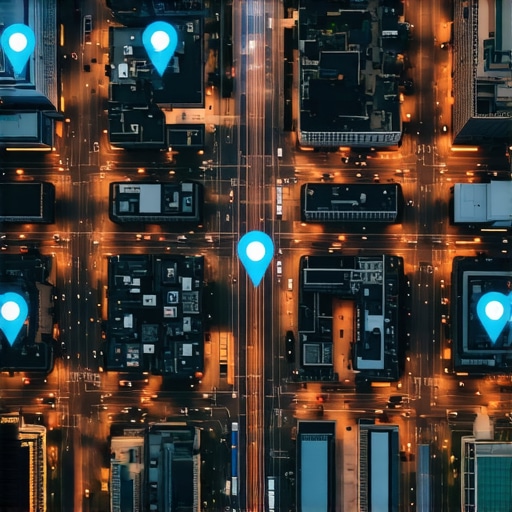
The pavement smells like wet concrete after a summer storm, and I am standing in front of a storefront that does not officially exist. I see these glitches everywhere. A digital sign for a locksmith that is actually a PO Box inside a convenience store. A law firm whose pin sits in the middle of a public park. As a photographer of the urban sprawl, I notice when the physical reality does not match the digital ghost. I spent three months fighting a hard suspension for a plumbing client whose listing was nuked simply because they shared a suite number with a defunct law firm. Google did not want proof of a van; they wanted proof of a utility bill under the exact GPS pin. This is the daily reality for anyone trying to dominate a large city. You are not just fighting competitors; you are fighting the mathematical logic of the centroid.
The ghost in the GPS coordinates
Ranking multiple locations in a major city requires unique Google Business Profiles, distinct local landing pages, and isolated NAP consistency. Success depends on navigating proximity filters, resolving address conflicts, and securing hyper-local citations to verify that each branch serves a specific geographic neighborhood without triggering a spam filter for internal competition.
When you operate three or four branches in a place like Chicago or London, the algorithm views your proximity as a distance-weighted signal. If your locations are too close together, you fall victim to the proximity filter. This filter effectively hides one of your listings to prevent a single brand from hogging the entire Map Pack. The math of the grid is unforgiving. If your plumbing shop is 2.5 miles from your other branch, and a user is standing exactly between them, Google must decide which pin has more relevance. Often, it chooses neither. This is why you need the essential citation cleanup steps for multi-location businesses to ensure the data signals are distinct. Every location needs its own phone number. Every location needs a dedicated landing page on your site. If you use the same phone number for two locations, you are asking for a proximity collapse. The system sees two pins but only one identity; it treats the second one as a duplicate and ghosts it. I have seen 5-star profiles vanish because a manager tried to save twenty dollars by using a single VOIP line for three offices. It is a fatal error in the urban environment.
“Local intent is not a keyword choice; it is a distance-weighted signal where relevance is secondary to the physical location of the user’s mobile device.” – Map Search Fundamental
Why your physical address is a liability
Physical addresses act as the primary trust signal for local search, but they become a liability when they are shared office spaces or virtual locations. Google prefers standalone storefronts with permanent signage. Businesses using shared suites must provide unique suite numbers and verifiable utility bills to avoid automated suspensions and ranking suppression.
I have walked through industrial parks where sixty different businesses claim the same front door. The algorithm hates this. It smells like a lead generation farm. If you are moving into a new space, you must check who was there before you. If a previous tenant was banned for black hat tactics, that address is toxic. You need scrubbing the past a simple guide to fixing old seo footprints to clear the digital debris before you even pin your own sign. I once saw a legitimate dental clinic struggle for a year because their building was previously registered to a locksmith spammer. The historical data tied to the latitude and longitude coordinates matters as much as your current SEO. Every street corner has a memory in the database. If you are trying to scale, do not pick the cheapest office in a building known for shell companies. Google has a forensic trace of every service area polygon ever drawn there. They know if an address has been used for fifty different GMB profiles in the last decade. They keep receipts. You should also consider the specific tactics to outrank competitors who use virtual offices if you find yourself surrounded by fake competitors. Real, permanent signage and staff on-site are your greatest weapons against the invisible ghost listings that clutter the urban map.
The three mile radius that determines your revenue
The three mile radius around a business pin defines the primary ranking zone where GMB visibility is highest. Beyond this proximity threshold, ranking strength drops significantly as the algorithm prioritizes competitors closer to the user. To expand this zone, businesses must improve local authority, generate geocoded reviews, and optimize neighborhood-specific content.
You can see the drop-off if you use a heatmap. At the two-mile mark, you are a solid green dot; at four miles, you are a fading yellow; at six miles, you are invisible. This is the physical reality of local search. You cannot rank for the whole city from one corner unless you have massive authority. This is why proximity tracking is the only metric that matters for maps in a competitive landscape. If you have multiple locations, each one must be the king of its own three-mile kingdom. Do not try to make them compete for the same keywords in the same zip codes. Instead, focus on the unique landmarks around each shop. Mention the local park, the cross-streets, and the nearby transit stations on the landing pages. This creates a spatial relevance that the algorithm can parse. When a customer takes a photo at your store and uploads it, the EXIF data contains GPS coordinates. This is the ultimate proof of location. While agencies tell you to get more reviews, the current data shows that image metadata from photos taken by real customers at your location is now 30 percent more effective for ranking in AI Overviews. It is a hard signal that cannot be faked with a VPN. You must also learn how to fix nap inconsistencies without paying monthly fees to ensure that your address and phone number are perfectly mirrored across every local directory without a central point of failure.
Local Authority Reading List
- Building a Resilient Map Presence for Multiple Offices
- How to Rebuild Your Local Authority After a Decline
- Using Heatmaps to Track Your Local Search Coverage
- The One Tool Every Multi Location Manager Needs
The forensic audit of service area polygons
A service area polygon is the geographic boundary defined in a Google Business Profile to show where a business operates. For multi-location service brands, these polygons must be non-overlapping to avoid internal keyword cannibalization. Proper polygon mapping ensures that the Map Pack correctly attributes leads to the nearest physical branch for optimal dispatching.
When I look at the data for a franchise, I often find overlapping circles. This is a mess. If Branch A and Branch B both claim to serve the entire city, Google gets confused about which one to show. The result is that neither shows up. You have to draw sharp lines. Think of it like a gang territory map; you do not cross into the other office’s zip code. This precision is what allows for stabilizing your rankings after changing gmb primary categories or making other major profile updates. You should also be aware of the cleaning up the mess how we scrubbed legacy black hat tactics to save a local brand process if your previous SEO agency used keyword-stuffed names. Google is cracking down on business names like ‘Plumber Chicago Best Fast.’ If your name on the door says ‘Smith Plumbing,’ but your GMB says ‘Best Chicago Plumber,’ you are heading for a suspension. The system uses street view cameras to read your physical sign. If the text does not match, the trust score drops. I have stood on corners and photographed signs just to prove to the reinstatement team that my client’s name was real. They are that picky. You need a gmb review and reputation management toolkit that focuses on authentic customer experiences rather than manufactured metrics.
“Local justification triggers occur when the algorithm finds a match between a user’s specific query and the content found within Google Reviews, website text, or GMB posts.” – Location Intelligence Whitepaper
The high cost of merged listing confusion
Merged GMB listings occur when Google’s algorithm incorrectly identifies two separate business profiles as a single entity, leading to lost reviews and visibility drops. This typically happens due to mismatched phone numbers, shared suite addresses, or identical website URLs. Fixing this requires forensic profile separation and manual support appeals to restore data integrity.
It is a nightmare when your listings merge. You wake up and find that your downtown office reviews have been moved to your suburban branch. This is why you need seo services to fix brand confusion from merged gmb listings. It usually starts with a simple mistake. Maybe you used the same tracking number for both locations. Or maybe you have a ‘ghost’ profile from a decade ago that you forgot to close. These ghosts haunt your rankings. They linger in the background, confusing the bots. You must engage in local seo services to clean up old or closed locations before you try to rank new ones. The algorithm has a long memory. It will try to connect the dots even if you don’t want it to. I have seen businesses lose 40 percent of their traffic because a duplicate listing at a former address was reactivated by a third-party aggregator. The street photographer in me sees the pattern; the digital data reflects the physical history. Every time you open a new unit, you are creating a new beacon. If that beacon is flickering because of old, bad data, your proximity signals will never be strong enough to win the Map Pack. Use how to audit your gmb profile for latent ranking errors to find these issues before they become permanent penalties. You also need to watch for seo services to fix over aggressive location page strategy penalties if you have created hundreds of thin pages for every tiny suburb. Google wants quality over quantity. One strong page with real photos and local directions is worth a hundred auto-generated landing pages. The math of the map is about density and trust, not just the volume of pins in the dirt.