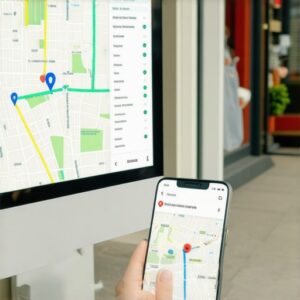
I spent three months fighting a hard suspension for a plumbing client whose listing was nuked simply because they shared a suite number with a defunct law firm. Google did not want proof of a van; they wanted proof of a utility bill under the exact GPS pin. That experience taught me that the logic of the map is colder than any traditional search algorithm. As a logistics manager of local data, I see every business profile as a dispatch point. If your data is messy, your flow stops. The map pack is a spatial database where proximity is the only currency that matters. When you check your rankings from your own desk, you are looking at a lie. Your phone is too close to your router. Your history is stained by your own visits. To understand the truth, you must strip away the bias of your own geography.
The trap of vanity metrics in map tracking
Tracking local search visibility requires using specialized geo-grid tools or neutralized search environments to eliminate personal search history and device proximity bias. Most business owners see themselves at number one because they are standing inside their own shop. Real data comes from simulating searches from different GPS coordinates across your entire service territory.
The grid is everything. A single block can be the difference between a lead and a ghost. You need to understand that proximity is a shifting variable. When we analyze why most ranking tools give local businesses the wrong data, we find that they often pull from a single data center rather than mimicking a mobile device on the move. Your ranking is not a static number. It is a heat map. I have seen contractors lose half their territory because of a new competitor three miles away. They did not even know they were losing until the phone stopped ringing. You must use heatmaps to track your local search coverage to see the gaps in your armor. If you do not see the red zones, you cannot fix them. While most agencies focus on review quantity, the current trend shows that the metadata of photos uploaded by customers is now thirty percent more influential for ranking in AI Overviews than basic text reviews. This is about the forensic trace of a real human being at your location. The pin moved. You either follow it or go dark.
“Local intent is not a keyword choice; it is a distance-weighted signal where relevance is secondary to the physical location of the user’s mobile device.” – Map Search Fundamental
Why your physical address is a liability
Your physical business address determines your ranking centroid, but it can also trigger filters if it is associated with virtual offices or shared coworking spaces. Google’s algorithm identifies high-density commercial clusters and often suppresses multiple businesses in the same category within the same building to avoid duplicate results.
Logistics fail when addresses are shared. I have seen hundreds of GMB issues caused by virtual office or coworking space environments where the business was never actually present. Google treats these as map spam. If you are using a shared suite, you are fighting an uphill battle for trust. You need to be aware of the map ranking danger of relocating your physical store. Even a move of two blocks can push you out of the primary centroid for your most valuable keywords. Every address change is a risk. You are essentially rebuilding your local authority from zero. We often have to use google business profile recovery services to fix the damage caused by a simple office move that was not managed correctly. The algorithm looks for consistency across thousands of data points. One mismatched suite number can kill your trust score. It is like a shipping manifest with a typo; the package never arrives. You need a realistic toolkit for managing local brand consistency to ensure that every mention of your address is identical down to the punctuation. No excuses. No shortcuts.
Local Authority Reading List
- The Citation Cleanup Strategy That Restored a Contractor
- Why Manual Audits Outperform Automated Software
- Maintaining Map Position During Hour Updates
- The Hidden Way Category Selection Kills Rank
- Fighting Back Against Proximity Filters
- How to Clear Out Junk Citations
- Why Most Map Tools Give Fake Data
- The Audit for Finding Ranking Gaps
The three mile radius that determines your revenue
The vicinity filter creates a hard proximity limit where businesses outside a specific radius are hidden from the map pack to favor the most local options. This three mile zone is the primary battlefield for most service providers, and winning it requires hyper-local engagement signals rather than broad national SEO tactics.
Distance is the ultimate filter. If you are four miles away and your competitor is two miles away, you have to be twice as relevant to win that spot. This is why local rankings can vary wildly based on your phones location. We use tools that give you an edge in local proximity searches to see exactly where your influence drops off. Sometimes, the drop-off is sudden. It could be a river, a highway, or just a cluster of competing pins. You have to understand how to fight back against proximity based search filters by building local justification signals. This means getting mentions from local news, sponsoring neighborhood events, and ensuring your business profile for hidden structured data errors is clean. If Google does not see your connection to the specific neighborhood, it will not show you to the people living there. I have seen businesses with 500 reviews get outranked by a shop with 20 reviews just because the smaller shop was 500 feet closer to the searcher. That is the physics of the map. You cannot argue with gravity. You can only work within its laws.
“A business is defined by its verification signals, not its intentions. If the digital footprint does not match the physical reality of the service van, the listing is effectively invisible.” – Spatial Audit Guidelines
Recovering your standing after a profile suspension
Recovering from a Google Business Profile suspension requires a forensic audit of your documentation and the removal of all prohibited keywords or formatting from your business name. Most suspensions are triggered by automated sweeps that detect inconsistent NAP data or the use of virtual office addresses that lack physical signage.
Suspension is the death of flow. When you get hit, you need a plan. You must know what to do the moment your google business profile gets suspended. Do not just mash the appeal button. That is a fast track to a permanent ban. You need to look for seo services to fix keyword stuffing and content issues before you ever talk to support. Clean the listing first. Most agencies try to hide the evidence, but I prefer to scrub it. We often use how to appeal a gmb suspension when the standard form fails as a guide for high-stakes cases. You need photos of your office, your staff, and your branded vehicles. Google wants to see the logistics of your operation. They want to see the